


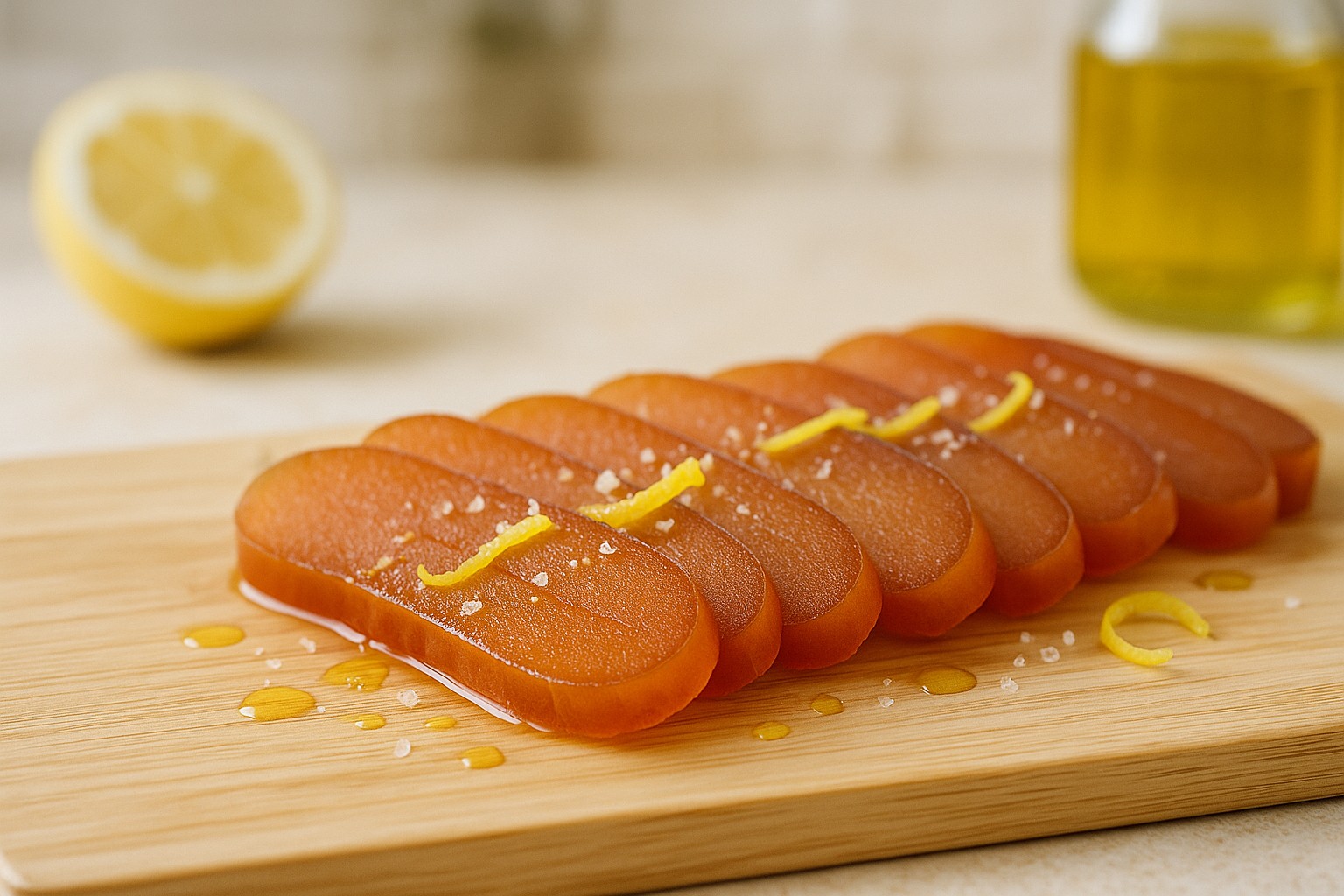
Poutargue: Definition, Taste, How to Choose and Eat It (Complete Guide)
Whether you’re discovering poutargue for the first time or looking to refine your selection, this guide gets straight to the point: understanding what it truly is, recognizing a quality piece (mullet vs. tuna, waxed vs. vacuum-sealed), storing it without altering its aromas, slicing it cleanly, and using it at the right moment (thinly sliced for appetizers or grated as a finishing touch).
You’ll also find simple sensory cues (color, texture, intensity), common mistakes to avoid, and quick pairing ideas to elevate your dishes.
What is poutargue (or bottarga)?
Poutargue (also called bottarga) is a pouch of fish roe — most often from mullet (mugil) and sometimes from tuna — that is salted, then dried and pressed until it forms a firm block that can be sliced or grated. In France, it is traditionally associated with the town of Martigues, where it’s affectionately known as the “Martigues caviar.”
What is it made of? Mullet vs. Tuna
Mullet: iodized, salty, slightly nutty profile with a firm texture that holds well when sliced — it’s the most common variety.
Tuna: stronger, darker, and often preferred by those who enjoy bold, intense flavors.
In both cases, the process is the same: the twin roe sacs are harvested at full maturity, salted, pressed, and dried.
How Koskas & Fils Crafts Its Poutargue, Generation After Generation
At Koskas & Fils, every poutargue begins with a gesture passed down through generations: carefully removing the double roe pouch intact, without piercing it. That’s the secret to a perfectly even texture.
Next comes the patient, measured salting stage. Each piece is turned, tasted, weighed, and noted. The salt should never dominate, it should reveal.
When the timing is right, the roe is pressed. Beneath the board, the mass unifies, takes on its distinctive shape, and releases excess moisture.
Then begins the most discreet part of the craft: controlled drying. Airflow, humidity, time — here, the eye and memory decide. Day after day, we monitor the color as it deepens to amber, the texture as it firms, and the aroma as it concentrates.
Finally, the poutargue is protected: traditionally coated in beeswax to preserve its perfect balance, or vacuum-sealed for more practical storage.
The result is our signature: a dense, clean-cut poutargue with a pure umami taste — one that slices thinly without crumbling and grates into even, delicate flakes. More than a recipe, it’s a legacy — a family craftsmanship refined and respected over generations.
What Does Poutargue Taste Like?
It has a clean, unmistakably marine flavor — both iodized and salty — with subtle notes of crustacean or sea urchin that gradually unfold. Depending on its maturation, a smoky depth may emerge, followed by a refined, noble bitterness that balances the whole.
When grated, poutargue enhances a dish much like anchovies or Parmesan would, adding an instant umami depth. When sliced, its fleshy texture reveals a rich, dense, and precise flavor profile that expands in the mouth without overpowering the other ingredients.
How to Choose Your Poutargue
1. Color & Texture
From light amber to brown — the darker the hue, the more pronounced the flavor (generally).
To the touch: firm yet supple, with no major cracks.
Surface: smooth and clean (when waxed) or tightly sealed (when vacuum-packed).
2. Wax vs. Vacuum-Sealed
Wax: protects and halts maturation, ensuring excellent long-term stability; the wax is removed before serving.
Vacuum-sealed: offers a more direct flavor, convenient for cold storage, though slightly less protective than thick wax.
3. Size & Shape
A dense, even pouch slices better for appetizers.
Smaller formats are ideal for grating over pasta, risotto, or eggs.
4. Origin & Aging
Origin: production can be found across the Mediterranean (Provence, Sardinia, Greece, Tunisia), though some raw materials are imported.
Aging: drying time affects both texture (from softer to firmer) and flavor intensity.
Storage & Shelf Life
Store in the refrigerator (4 °C / 39 °F).
Wax-coated: excellent stability; once opened, wrap the cut surface tightly in plastic film and refrigerate again.
Vacuum-sealed: follow the producer’s best-before date; once opened, consume within a few weeks and avoid moisture.
Keep away from strong odors (cheese, onions), as poutargue is highly absorbent.


